Conjugation with Control.
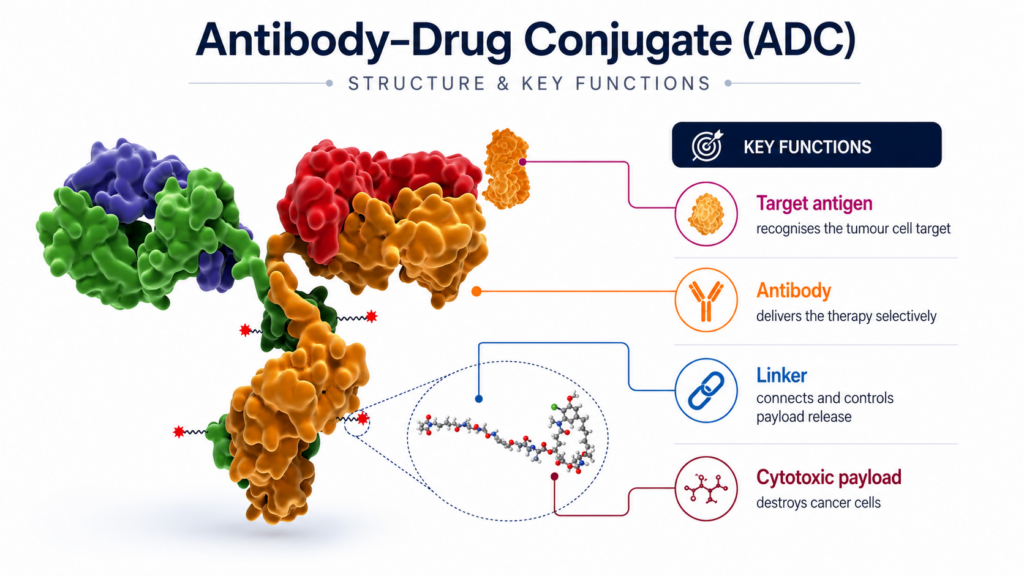
Talia Biologics provides ADC and bioconjugation CDMO services for sponsors developing antibody-drug conjugates, peptide conjugates, radioconjugates, protein-polymer conjugates, diagnostic conjugates, antibody-enzyme conjugates, and targeted biologic systems that require chemistry, biology, analytics, drug product, and GMP execution to move together.
ADCs and bioconjugates are not ordinary biologics with a decorative chemical attachment. They are integrated therapeutic systems. The antibody, protein, peptide, linker, payload, conjugation site, drug-to-antibody ratio, impurity profile, aggregation risk, potency assay, formulation, sterile fill, containment strategy, and regulatory package all influence one another.
That is why Talia’s approach is simple:
Conjugation with Control.
We support programmes where specificity must meet potency, and where elegant molecular design must survive real manufacturing conditions. A conjugate may look glamorous in a pipeline deck, but the actual product still has to tolerate buffers, purification, filtration, filling, freezing, thawing, storage, shipment, inspection, release testing, and clinical use. The science may be gorgeous. The process still has to work.
From Taipei, Taiwan; Stuttgart, Germany; and Charlottetown, Prince Edward Island, Canada, Talia supports sponsors across Asia-Pacific, Europe, and North America with a CDMO model built for complex biologics and nonstandard modalities. Taipei gives us speed and technical responsiveness. Stuttgart gives us process discipline, quality structure, and European manufacturing rigour. Charlottetown gives us focused North American biomanufacturing strength, applied biotechnology, and practical execution for specialty biologics.
Together, these locations support a single operating idea: complex products need integrated development.
For ADCs and bioconjugates, that integration matters from the first feasibility conversation.
Why ADCs and Bioconjugates Need a Different CDMO Model
Bioconjugates punish fragmented development.
A sponsor may have a strong antibody programme, a promising linker-payload, a credible mechanism, and encouraging early data. That does not mean the product has a controlled manufacturing path.
ADC and bioconjugate development requires several disciplines to operate as one system:
- Antibody or protein quality
- Linker-payload properties
- Conjugation chemistry
- Site selection or stochastic distribution
- DAR control
- Free payload removal
- Aggregate control
- Potency and binding analytics
- High-potency handling
- Drug substance purification
- Sterile drug product
- Stability
- Comparability
- CMC documentation
- Clinical supply
A standard biologics CDMO may understand expression and purification but miss the risk introduced by payload hydrophobicity. A chemistry-focused partner may understand the payload but not the behaviour of the antibody. A fill-finish provider may understand sterile operations but not how conjugation changes aggregation, adsorption, viscosity, or stability. A sponsor may then need to monkey together four different vendors and hope the programme still has one coherent story.
Talia helps prevent that.
We treat the conjugate as a complete product system. The molecule, chemistry, process, analytical package, formulation, container, and supply chain all belong to the same development logic.
That view is not ornamental. It determines whether the product can move from research material to GMP supply without losing control.
Talia ADC CDMO Capabilities
Talia supports ADC programmes across development, manufacturing strategy, analytical control, drug product planning, and CMC rescue.
Our ADC CDMO services may include:
- Antibody intermediate assessment
- Linker-payload strategy
- Conjugation process development
- Site-specific conjugation support
- Stochastic conjugation support
- DAR distribution strategy
- Free payload and residual linker control
- Aggregate reduction
- Purification and polishing
- Ultrafiltration and diafiltration
- Buffer exchange
- Formulation screening
- Stability strategy
- Analytical method development
- Binding and potency assay planning
- High-potency handling strategy
- Sterile drug product planning
- Lyophilisation cycle development
- Clinical supply coordination
- CMC documentation support
- Tech transfer and process rescue
Talia supports conventional ADCs as well as more specialised conjugate formats, including bispecific ADCs, dual-payload ADCs, immune-stimulating ADCs, radionuclide-antibody conjugates, peptide-drug conjugates, antibody-enzyme conjugates, antibody-oligo conjugates, protein-polymer conjugates, fluorescent diagnostic conjugates, albumin-binding conjugates, and other targeted therapeutic systems.
That range matters because ADC development no longer sits inside one neat box. The field has expanded from classic antibody-cytotoxin constructs into broader targeted delivery systems. Some products behave like antibodies. Some behave like small molecule-linked biologics. Some look like a lizard under stress: recognisable, but suddenly not the same animal after heat, shear, light, oxidation, or freeze-thaw exposure.
Talia helps sponsors understand those behaviours before they become late-stage surprises.
Bioconjugation Beyond ADCs
Many CDMO pages treat bioconjugation as a synonym for ADC development. Talia does not.
ADCs represent one major category, but bioconjugation CDMO services now reach across oncology, imaging, diagnostics, immunology, rare disease, animal health, and advanced delivery. The broader field includes targeted proteins, peptides, enzymes, polymers, oligonucleotides, radioligands, diagnostic labels, and half-life extension technologies.
Talia supports this broader conjugation landscape.
Peptide Conjugates
Peptide conjugates may include peptide-drug conjugates, peptide-radionuclide conjugates, peptide-lipid conjugates, GLP-1-related conjugates, albumin-binding peptides, and long-acting peptide formats.
These products require more than synthesis. A peptide conjugate may need impurity control, conjugation-site understanding, formulation, sterile fill, lyophilisation, depot delivery, or radiolabeling strategy.
Radioconjugates
Radioconjugates and radiopharmaceutical precursors require chelation strategy, isotope-linked process discipline, short half-life logistics, fast QC, sterile handling, and tight coordination across development and supply.
Talia supports radioconjugate CDMO planning where peptide, antibody, chelator, isotope, analytical method, and sterile product requirements must align.
Diagnostic Conjugates
Diagnostic conjugates may include antibody-dye conjugates, antibody-enzyme conjugates, fluorescent labels, lateral-flow reagents, imaging agents, and IVD-supporting proteins.
These products may not require the same regulatory path as therapeutic ADCs, but they still need consistency, purity, stability, and analytical clarity.
Protein-Polymer Conjugates
Protein-polymer conjugation may support half-life extension, solubility, stability, controlled release, reduced immunogenicity risk, or altered biodistribution.
Talia supports programmes where polymer conjugation changes not only the molecule but also the downstream process, analytics, formulation, and final product behaviour.
Antibody-Oligo and Protein-Nucleic Acid Conjugates
Antibody-oligo conjugates and protein-nucleic acid conjugates represent a more future-facing class of products. They juxtapose biologic specificity with nucleic acid function, creating new opportunities and new CMC risks.
Talia helps sponsors assess these hybrid systems with a practical question: can the product be made, measured, stabilised, transferred, and supplied?
That is the right question for every bioconjugate.
Linker-Payload Strategy and Conjugation Control
The linker-payload system often defines the ADC.
It influences potency, stability, hydrophobicity, solubility, aggregation, off-target toxicity risk, release mechanism, purification burden, formulation, and final drug product behaviour. In ADC development, “payload” should never become a pejorative shorthand for an afterthought. The payload often determines the entire manufacturing risk.
Talia supports linker-payload and conjugation development with attention to:
- Cleavable versus non-cleavable linker strategy
- Payload hydrophobicity
- Conjugation chemistry
- Site-specific versus stochastic conjugation
- DAR distribution
- Batch-to-batch reproducibility
- Free drug removal
- Residual linker and payload impurities
- Aggregate formation
- Stability under process and storage conditions
- Binding retention
- Potency retention
- Process scalability
- Analytical method suitability
- Drug product compatibility
A conjugation process must create the right product profile, not merely attach a payload. The process must deliver reproducible distribution, acceptable purity, controlled impurities, retained biological function, and a stability profile that supports clinical use.
A process built for 5 mg discovery material cannot simply stretch into GMP like a giraffe reaching for a higher branch. Scale changes mixing, timing, exposure, recovery, analytical expectations, safety requirements, and documentation.
Talia develops conjugation control with scale in mind.
Analytical Development for ADCs and Bioconjugates
Analytics are not downstream paperwork. In ADCs and bioconjugates, analytics are the steering wheel.
Talia supports ADC analytical development and bioconjugate characterisation with methods and strategies designed to understand the product profile, guide process development, support comparability, and prepare for GMP release.
Analytical areas may include:
- DAR analysis
- Free payload analysis
- Residual linker assessment
- Aggregation analysis
- Size variant analysis
- Charge variant analysis
- Hydrophobic interaction chromatography
- SEC, IEX, RP-HPLC, and orthogonal purity methods
- LC-MS and intact mass analysis
- Peptide mapping
- Binding assays
- Potency assays
- Cell-based functional assays
- Stability-indicating methods
- Forced degradation studies
- Endotoxin and bioburden strategy
- Residual impurity analysis
- Comparability studies
- Formulation-linked analytics
- Release method planning
A sponsor cannot control what it cannot measure. This becomes especially true for ADCs, where a single “purity” value may hide critical differences in DAR distribution, free drug, aggregate species, charge variants, hydrophobic variants, or potency loss.
Talia helps sponsors define the analytical panel around the actual product risk. We do not treat every conjugate as a generic molecule with a generic method list.
If the conjugate has a cytotoxic payload, the analytical approach must address safety and residual free drug. If it has a radiolabeling step, the approach must account for time-sensitive release and chelation performance. If it has a polymer conjugate, the method package must distinguish product distribution from uncontrolled heterogeneity. If it has a peptide payload, impurity logic may differ from an antibody-payload system.
The method should follow the molecule.
Potency, Binding, and Functional Control
ADC and bioconjugate potency requires more than one measurement.
A sponsor may need to understand antigen binding, internalisation, linker stability, payload release, cell-killing activity, receptor engagement, enzymatic activity, immune activation, or another mechanism-specific function.
Talia supports potency and binding strategy for ADCs and bioconjugates by helping sponsors define what the product must do and how that function should be measured.
For some products, a binding assay may provide an early screen but not enough functional confidence. For others, a cell-based potency assay may become programme-defining. For an immunocytokine or antibody-enzyme conjugate, the assay may need to capture both targeting and functional activity. For a diagnostic conjugate, signal consistency and binding specificity may matter more than therapeutic potency.
Talia helps sponsors avoid vague potency language. The assay must connect to the product’s purpose.
This is especially important during comparability work, process transfer, stability studies, and CMC rescue. If the programme cannot show that function remains intact after conjugation, purification, formulation, and storage, the development path remains weak.
High-Potency Biologics and Containment Strategy
Many ADCs and peptide-drug conjugates involve potent payloads, cytotoxic intermediates, or high-potency drug product requirements.
Talia supports high-potency biologics CDMO strategy with attention to occupational exposure, containment planning, material handling, cleaning expectations, segregation, waste handling, analytical safety, partner qualification, and sterile drug product alignment.
High-potency products require serious operational discipline. They do not tolerate casual vendor handoffs or unclear facility assumptions. A sponsor must understand where the payload enters the process, how the material moves, how personnel remain protected, how residues get controlled, how cleaning gets documented, and how the final drug product pathway supports safety and quality.
Talia can support strategy, development planning, vendor coordination, and qualified infrastructure alignment for programmes involving:
- ADC linker-payload systems
- Cytotoxic ADC intermediates
- Peptide-drug conjugates
- Potent oncology biologics
- Payload-containing sterile products
- High-potency injectable formats
- Complex conjugate drug product
The CDMO path must account for people, process, product, facility, and evidence. Talia builds that thinking into the programme early.
Drug Product, Fill-Finish, and Lyophilisation
ADC and bioconjugate development does not end with a purified conjugate.
The product must become a sterile, stable, usable drug product. This step often introduces risk: aggregation, adsorption, concentration limits, filtration loss, light sensitivity, oxidation, freeze-thaw damage, container interaction, silicone oil effects, leachables, particles, reconstitution issues, and cold chain dependence.
Talia supports ADC sterile fill-finish and bioconjugate drug product development for liquid and lyophilised formats, including:
- Sterile vial filling
- Low-volume fill
- Lyophilisation cycle development
- Formulation screening
- Buffer and excipient strategy
- Aggregation control
- Adsorption reduction
- Container closure evaluation
- Extractables and leachables planning
- Light sensitivity planning
- Cold chain strategy
- Clinical packaging
- Release testing alignment
- Small-batch clinical supply
Drug product must reflect the conjugate’s actual behaviour. Some ADCs need lyophilisation to protect stability. Others require liquid formulation with careful excipient selection. Some products may need low-temperature handling, protection from light, or highly specific container closure decisions.
Talia connects drug substance and drug product thinking before the programme locks into a format that creates avoidable risk.
CMC Rescue for ADCs and Bioconjugates
ADC and bioconjugate programmes can stall for many reasons.
The DAR drifts. Aggregation rises. Free payload remains too high. Recovery drops. The linker behaves badly. The potency assay lacks sensitivity. A transfer package misses key process details. The conjugate looks acceptable by one method and problematic by another. The sterile fill partner finds instability. The high-potency pathway was not planned early enough. The product works in research but becomes chaotic during GMP preparation.
Talia supports bioconjugate CMC rescue for programmes under pressure.
Common rescue situations include:
- Poor conjugation reproducibility
- DAR distribution problems
- High aggregation
- Low recovery
- Free payload issues
- Weak potency assay
- Binding loss after conjugation
- Incomplete analytical package
- Failed scale-up
- Unstable formulation
- Fill-finish delays
- High-potency handling gaps
- Poor comparability
- Incomplete batch history
- CDMO transition failure
- Documentation gaps
Talia starts by reviewing the product, process history, analytical data, batch records, deviations, formulation information, impurity profile, stability data, and target timeline. Then we identify what can be recovered, what needs redevelopment, and what must change before the next batch.
When the path breaks, Talia rebuilds it.
That line matters most in ADCs and bioconjugates because the failure point often hides between disciplines. The chemistry team may think the biologic is the issue. The biologics team may blame the payload. The drug product team may blame the conjugation process. The assay team may discover the real answer three months too late.
Talia brings the pieces back into one CMC system.
ADCs und Biokonjugate brauchen mehr als Kapazität. Sie brauchen kontrollierte Chemie, klare Analytik, robuste Dokumentation und eine Herstellungsstrategie, die Produktqualität von Anfang an schützt. Talia verbindet Entwicklung, GMP-Denken und Drug-Product-Realität zu einem präzisen, skalierbaren Weg.
Our Niche Capabilities
Talia supports several advanced capability areas that many CDMO platforms mention only vaguely or avoid entirely.
These include:
- ADC and bioconjugation development
- Linker-payload control
- Peptide-drug conjugates
- Peptide-radionuclide conjugates
- Antibody-oligo conjugates
- Protein-polymer conjugates
- Diagnostic conjugates
- Radioconjugate strategy
- High-potency biologics planning
- Short half-life sterile manufacturing logic
- Low-volume sterile fill
- Lyophilised conjugates
- Potency assay development
- DAR and free payload analytics
- Extractables and leachables planning
- CMC rescue for failed conjugate programmes
- Tech transfer between biologics, chemistry, and fill-finish vendors
- Clinical supply for high-value small-batch products
Talia does not claim every conjugate should follow one platform. That would be too simple. The value comes from knowing which parts of the platform apply and which parts need custom development.
A bispecific ADC, a peptide-radionuclide conjugate, and a fluorescent diagnostic antibody may all involve conjugation. They do not share the same development path.
Talia helps define the right path.
Who Talia Supports
Talia supports sponsors developing targeted biologics, complex oncology products, diagnostic conjugates, specialty peptides, and advanced delivery systems.
We work with:
- Virtual biotech companies
- Oncology sponsors
- ADC platform companies
- Peptide therapeutic companies
- Radiopharmaceutical developers
- Diagnostic companies
- Animal health innovators
- Rare disease companies
- Biopharma teams with internal discovery and external CMC needs
- Sponsors transferring away from a prior CDMO
- Companies preparing for IND-enabling work
- Teams that need process rescue or analytical clarity
Some sponsors come to Talia with a nearly complete package. Others arrive with a molecule, a deck, a few assays, and a deadline. Both situations can work if the programme becomes organised quickly.
The goal is not to make the page sound huge for the sake of sounding huge. The goal is to make the product path clear.
What to Include So Talia Can Route Your Programme
To help Talia review your ADC or bioconjugate programme quickly, include the modality, development stage, target timeline, expected scale, conjugation format, antibody or protein status, linker-payload information if available, analytical package, route of administration, formulation status, GMP needs, and any prior process issues.
Useful details include:
- Target antigen or product class
- Antibody, peptide, protein, or scaffold status
- Linker-payload type
- Site-specific or stochastic conjugation preference
- Current DAR target
- Batch size or expected scale
- GMP or non-GMP need
- Analytical methods already in place
- Potency assay status
- Formulation and stability data
- Intended drug product presentation
- Prior batch history
- Known process failures
- Target milestone
Incomplete information is fine. Early-stage conjugate programmes often begin with missing pieces. Talia can help define what needs to be generated next.
Why Talia for ADC Bioconjugation CDMO Services
Talia Biologics supports ADCs and bioconjugates with a CDMO model built around the whole product system.
We do not treat conjugation as an isolated chemistry step. We connect conjugation with antibody or protein quality, purification, analytics, potency, containment, formulation, fill-finish, stability, clinical supply, and CMC documentation.
That broader view makes Talia a strong fit for complex programmes where standard CDMO categories fall short.
Talia brings together:
- Taiwanese speed and technical responsiveness
- German process discipline and quality structure
- Prince Edward Island practicality and North American biomanufacturing strength
That combination gives sponsors a partner that can move quickly without losing control.
Bring us the molecule, the stage, the mess, or the almost-working process. Talia will help define the path.